Being Neighbors
When I first learned that a local interfaith gathering had been organized on the theme of “Won’t You Be My Neighbor,” I was delighted. Surely being good neighbors to one another is precisely what people in Minnesota have exemplified in recent weeks and, in doing so, inspired similar efforts across the country.
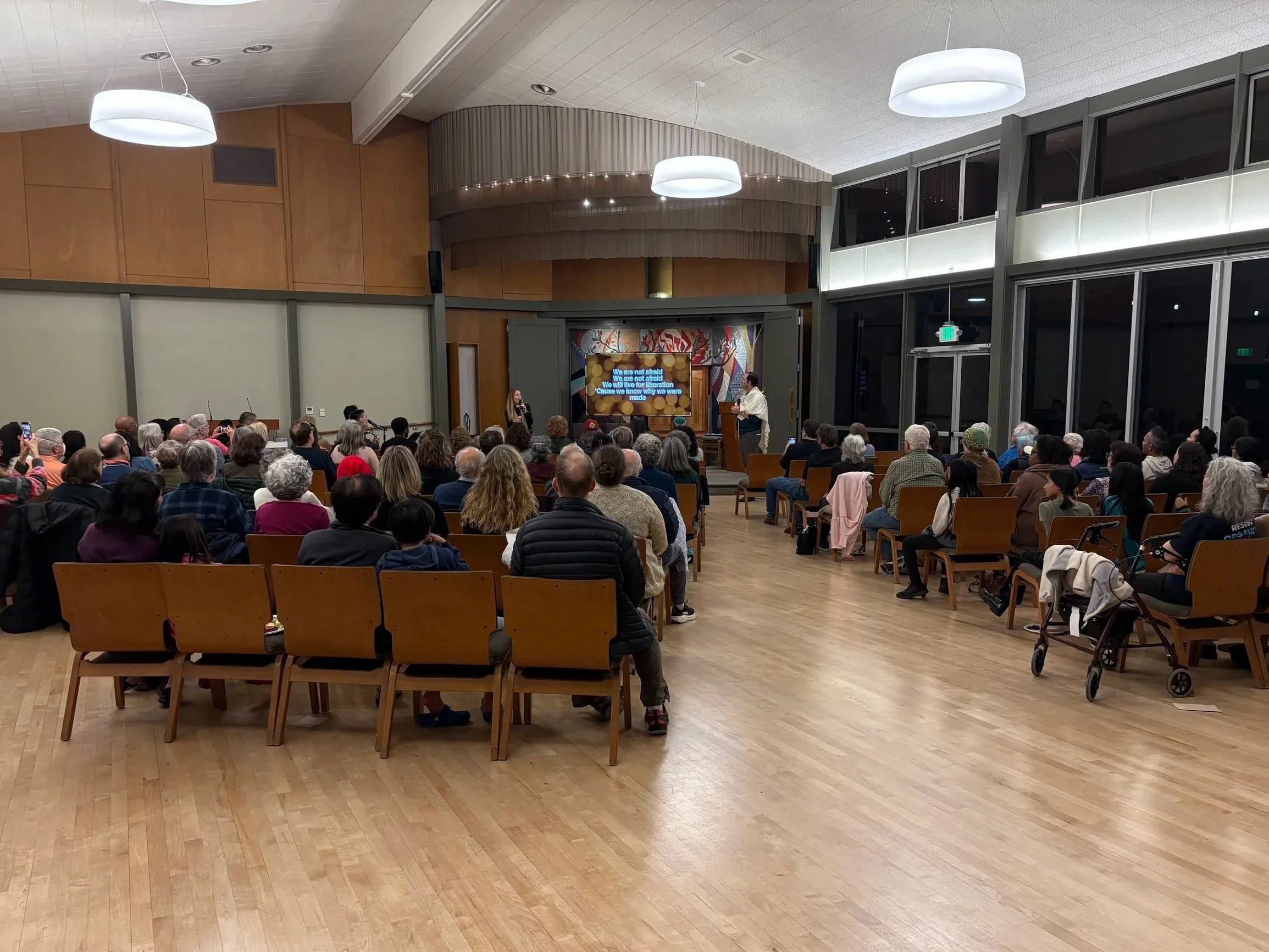
The event was held one evening at my synagogue, which shares its facilities with a dynamic Christian church. I arrived not really knowing what the program would consist of and was somewhat surprised to discover that it was almost entirely a singing event. Together we sang songs of love and solidarity, and listened to messages of hope in response to the challenges of these times.
There we were, perhaps one hundred of us, from a range of backgrounds, faiths and communities, many of us strangers to one another, but united in standing up to say: we will protect our neighbors. We do not approve of the policy of mass deportation and even less of the cruel and ruthless way in which it is being executed. As one song so aptly puts it, “If they want to come for you, they’ll have to come through us.”
The energy was infectious, the sense of moral outrage so powerful, and the spirit of joy and love so beautifully expressed. I feel confident that everyone left that evening uplifted and energized, inspired by the heartfelt expressions of our common humanity and the determination to resist. And I wondered what would happen if there were hundreds, then thousands, of such events across the country.
We are currently witnessing what happens when the government employs police-state tactics--the cruelty unleashed on children, the revoking of protections from those who have been granted haven in this country, the degrading and hateful rhetoric, the warrantless searches, the refusal to investigate those who murdered US citizen protestors, the quotas imposed on agents to capture and deport, the immense resources devoted to this operation, the persistent lies about what ICE is doing even in the face of incontrovertible evidence that contradicts them, the utter spectacle of it all. This is what the unleashed exercise of state power looks like, unconstrained by conventional norms or the rule of law, willing to challenge anyone that dares to defy them.
The brutality and the hateful rhetoric are assaults on the most fundamental of social values, which are at the core of religious and humanistic teachings alike: we are all fundamentally the same. We are all deserving of respect by virtue of our essential humanity. We all need one another. Our fates are intertwined.
The current administration, like all authoritarian regimes, has openly and baldly attacked all these fundamental values. Those who think what we’re experiencing is merely a more intense example of typical partisan fighting mistake what is happening. We are in a great moral struggle between those who affirm that all people are entitled to be treated with basic human dignity and those who would deny that dignity to people they have marginalized and vilified.
Won’t You Be My Neighbor?
The very simplicity of that question, made famous by Mr. Rogers, addresses precisely what these times ask of us: Will we identify with those who are labeled as ‘other’? Will we recognize our shared humanity? Will we act as neighbors? Will we show up and make common cause with others across our community?
“Won’t You Be My Neighbor?” is the perfect response to this assault on basic social and human values. We affirm our connection with one another. We resolve not to let the forces that vilify others prevail. We raise our voices, knowing that there are others across the country who are holding vigils, walkouts, and engaging in acts of solidarity and community-building.
In commenting on the well-known biblical injunction (Leviticus 19:18), ‘Love your neighbor as yourself,’ the eighteenth-century rabbi Naphtali Hertz Weisel notes that the underlying principle is that ‘your neighbor’ is ‘like yourself.’ (Essentially, ‘as yourself’ is not an adverb modifying how we are to love, but an adjective modifying ‘your neighbor’.) In these times, simply expressing our common humanity is the most immediate and perhaps the most effective way to counter the assault on others.
Affirming our neighbor-ness, our commonality, our need for one another and our desire to live peacefully in community with one another—all of us can find ways to express our commitments to this vision. But we must express them. We must be clear about what is at stake and we must act to defend human decency.
Rabbi Joachim Prinz, the great civil rights leader, said in the speech he gave at the March on Washington in 1963: "Neighbor is not a geographic term. It is a moral concept. It means our collective responsibility for the preservation of man's dignity and integrity."
Today, we are all being asked Mr. Rogers’ question: Will we be genuine neighbors to one another? All of us must stand together to answer in the affirmative.