Minnesota: A Model for Resistance
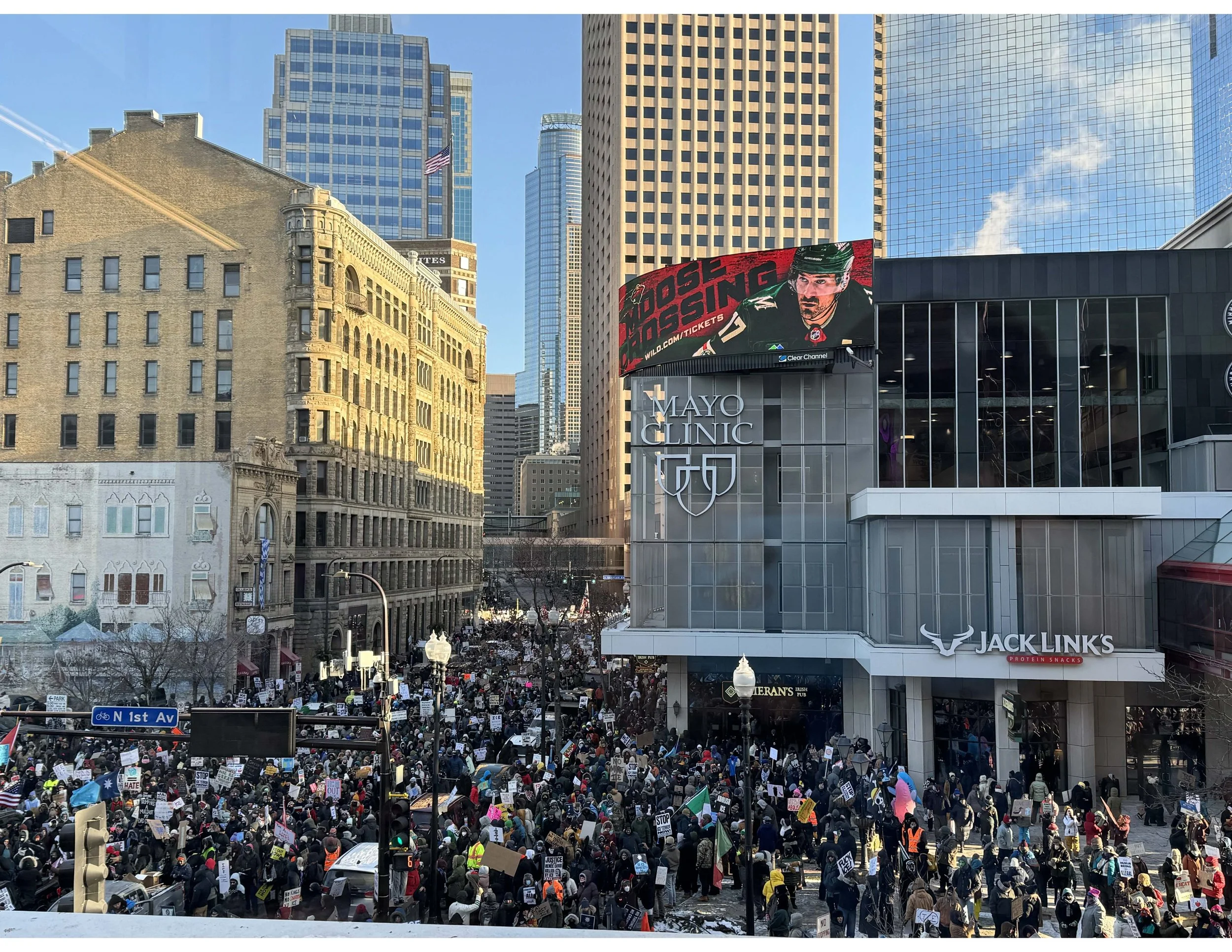
This post will be a little longer than usual. I just returned from a week in Minnesota and, to say the least, there’s a lot going on.
I admit it—I am a proud Minnesotan, raised in the political culture that produced Hubert Humphrey and Walter Mondale, a place that prides itself on civic mindedness and on welcoming tens of thousands of immigrants from places as distant as Laos and Somalia.
Still, nothing in my background or in that idealized image of my home state prepared me adequately for the experience of communal solidarity I witnessed this past weekend in Minneapolis. On Friday, some tens of thousands of people braved the subzero temperatures to express the message that ICE agents are the threat to our cities, not undocumented immigrants. “ICE Out” signs are ubiquitous, as are posters with the image of Renee Good and the caption: “American Mom. Murdered by ICE.” As I watched people streaming through the streets of downtown Minneapolis on the coldest day of the year, I was moved to tears to observe ordinary citizens expressing their moral outrage at the actions of their government against their neighbors. And that outrage was expressed peacefully, directly and forcefully. The protest was an expression of defiance and of hope.
I also observed expressions of resistance in Minnesota that are less dramatic, but more pervasive and even more impressive. Throughout the community, across civic and religious organizations, non-profits and neighbors organizing their own networks of communication and support—many centers of activity are resisting ICE and supporting vulnerable people in remarkable ways. Here’s a very partial list of the things people are doing across the Twin Cities to protect their neighbors and counter ICE activity:
· delivering groceries to people who are afraid to leave their homes;
· driving their kids to and from school;
· patrolling neighborhoods around schools and medical clinics;
· patrolling streets, looking for ICE vehicles, trying to slow them down, sounding whistles when they are sighted to alert neighbors;
· self-organized neighborhood groups that maintain records of verified ICE vehicles, to help those on patrol verify which black vans are ICE;
· an immigrant church that maintains its own medical clinic for immigrants who are injured in encounters with ICE;
· families writing messages of solidarity that are delivered to people afraid to leave their homes;
· notaries going to people’s homes to notarize legal documents (power of attorney and designation of parental authority), documents parents need in case they get detained;
· businesses converting themselves into collections sites and resource centers;
· businesses hosting whistle-kit making parties;
· people using 3-D printers to make whistles and donating them to the cause (and organizing others to do so);
· singing brigades and the “solidarity brass band" patrolling neighborhoods and calming tensions;
· restaurants providing free meals;
· people organizing to support immigrant-led businesses;
· countless Go Fund Me campaigns to provide food and rent for families whose primary breadwinners are afraid to go to work;
· people driving immigrants to doctors’ appointments;
· health care providers making home visits;
· clergy accompanying people to court;
· neighborhood solidarity groups to protect neighbors;
· countless trainings on constitutional observing
Minnesota has become ground zero for the administration’s authoritarian and police state tactics against citizens and non-citizens alike. But it has also provided the model for resistance as the stakes continue to get higher. As these examples illustrate, the most effective forms of resistance involve mobilization through hubs of activity that are centered throughout the community, in every kind of religious and civic group, as well as organically among neighbors.
Here’s the key: they have guns, but we have numbers. If we connect and communicate, we can support one another. Those relationships are the secret to resisting the authoritarian take-over of our country.
Resistance is expressed most often and most importantly in thousands of small acts of support and non-cooperation. It is built and sustained through interpersonal connections and a massive outpouring of support and solidarity with others, especially those with whom we rarely interact, if ever.
When the history of this period is written, people will note that in response to these cruel measures, thousands of ordinary citizens in Minnesota reached out to one another and resisted. This is exactly what resistance looks like. We should all note it well, for it is highly likely that this terror will continue. We know what it takes to defeat those forces, and in Minnesota we have a model of how to do it.
Across the country on Saturday night, people stood outdoors holding candles to express solidarity with the struggle that is playing out in Minnesota. The murder of Alex Pretti, just as the community had turned out by the thousands to demand that ICE leave Minnesota, left everyone reeling, in shock, despair, and grief. And it also galvanized again the incredible resolve of this community to resist this unconstitutional and unconscionable aggression. Almost immediately there was a plan to have people gather in small groups throughout the city, holding candles and expressing support for one another.
That night, alongside my wife, my son and two of our grandchildren, I stood with a group of perhaps forty of my son’s neighbors, just a few blocks from where Renee Nicole Good was murdered. We sang, gathered around a fire pit, holding our candles, expressing gratitude for all the ways in which people are showing up to support their neighbors. It was part vigil, an opportunity to express profound sadness, and part celebration of the human connections among us and what we can accomplish if we join forces and resist an oppressive government.
I left that gathering feeling the weightiness of the moment we are in, the sheer grief that is multiplied when people gather to share it. But I was also lifted up, by witnessing the power of human connection and the resilience of people who are under attack, yet responding resolutely and, overwhelmingly, with great dignity and restraint. This is what it takes to defeat authoritarians—get together, hold hands, help each other out, and push back against these immigration policies and their draconian enforcement. Each of us can do one of the small acts of support and resistance described above, or others of your choosing that are equally effective.
This is what resistance requires--that all of us stand up, get out, and express our moral condemnation of this government. The path is clear; the time is now. If events of the last few weeks have demonstrated anything it is that the authoritarian crisis has arrived. We have seen it most dramatically and tragically on the streets of Minneapolis. Let us resolve to resist together. Let us learn from the good people of Minnesota how we win.