A quick note before I begin: I am posting this just a few days after the midterm election, though I began writing it on the afternoon of Election Day before any results had been reported. I am as elated as everyone else about the outcome and I hope that this represents a major shift in the political landscape in our country. Down the road, I expect I’ll write about the implications of this major realignment of the electorate. But here I want to focus on the significance of elections themselves, which is separate from the question of whether we win, lose or draw.
*******************
Throughout my life, I had always assumed I basically knew how elections work. This year, at seventy, I decided for the first time to get involved in the process. What I learned was both routine and inspiring.
I have memories as a child of going to vote with my mother. Even then I grasped that what we were doing was important and somehow at the heart of what it meant to be an American. Years later, when I took my own kids to vote with me during their elementary and middle-school years, I always made a point of emphasizing that, for all of our country’s problems, we have free and fair elections in which we choose our own leaders and representatives. It is the very essence of being a free people.
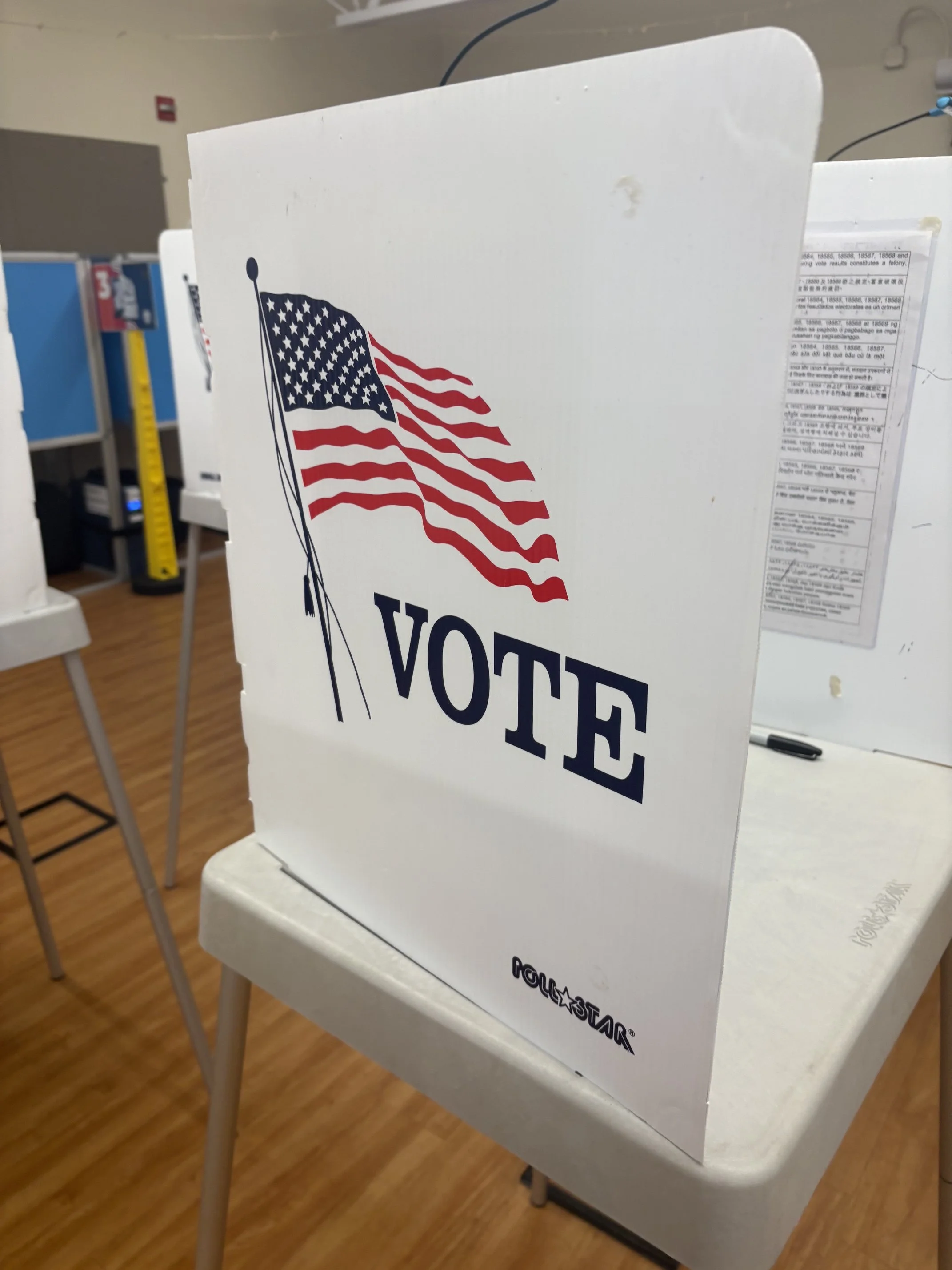
This year both Amy and I served for a day as poll workers, which involved mostly greeting people, directing voters to the right station, or offering them the right form, if they needed one. The Monday before Election Day, though, was a very slow day. Few people stopped by to vote, and those who came mostly just wanted to drop off their mail-in ballot. It was a fairly boring day, overall.
But what I learned--from the bit of work I did, but even more from the 3-hour training I was required to take, as well as from observing the process up close—is how very carefully orchestrated and strictly monitored the entire process is. The care that is taken to ensure that no worker sees or touches a voter’s ballot, that voter anonymity is preserved, that the polling station is entirely accessible (without regard to physical disability or language barriers), that the security of the ballots is so scrupulously guarded, that the procedures and forms for all types of voters are clearly articulated and applied completely impartially, and especially, that interference with the voting process, including any campaigning near the polling place, is absolutely forbidden.
This is precisely what a free and fair electoral process looks like. Nothing about it was exactly news to me, but seeing it up close reminded me of what we so often just taken for granted—that we rely on the security of our elections as a pillar of our democracy. It is surely not a perfect system, but overwhelmingly it works, thanks to the small army of public servants and volunteers who ensure that the voting procedures are fair and consistently followed.
We are living, of course, at a time of rampant election disinformation and relentless efforts by Trump to discredit the electoral process, disenfranchise minority voters, and pursue every possible avenue to interfere with the state-run elections process. It was in response to those assaults on our electoral system that Amy and I both decided this year to support the electoral process, if only in the smallest of ways.
Having now experienced in a more immediate way than ever before just how safe and secure our elections are, I appreciate even more the severity of the threats posed by the administration to our electoral process and to our democracy. Precisely because of the stakes involved, we need to strengthen our determination to protect our elections. This is not a political question about which we can seek compromise. It is the essential foundation of everything else. Without free and fair elections, our democracy ceases to function.
But elections aren’t just key to representative government; they are an expression of civic engagement. For the existence of free elections would mean little if people in very large numbers didn’t exercise their right to vote. And watching voters lining up to cast their ballots was more moving than I had anticipated.
On Election Day, we both served as poll observers for the CA Democratic Party. I was assigned to a polling station adjacent to a library in east San Jose, a predominantly east Asian neighborhood. For a few hours, I watched as people lined up to cast their ballots. They were a cross-section of young and old, first-time and very experienced voters, native English speakers and people who relied on material in one of the dozen or so foreign languages that was available. It was entirely unremarkable and routine. No glitches, no drama, no problems of any kind to report back to the Democratic Party.
But what I wanted to report was how utterly inspiring and beautiful it all was. People from all backgrounds and walks of life coming together to express their views about the kind of government and country they want. Without saying a word to one another, they communicated, as if in one voice, “we are here exercising our right to express our political preferences, to ensure that we are heard, because we believe in the integrity of this system and affirm the importance of participating in it.”
They were uniformly calm and attentive, patiently waiting for their turn, happy to be exercising their right to vote. One of the poll workers with whom I chatted mentioned that some voters take a selfie as they feed their ballots into the scanner. I can’t think of more powerful evidence that these voters understood the significance of what they were doing.
It was implicitly a repudiation of all the disinformation and election denialism promoted by the President and his cronies. But more than that, it was a demonstration of patriotism without a hint of the jingoism that so often infects our displays of nationalist pride. Utterly routine, completely unremarkable, and totally awe-inspiring.
This is truly what democracy looks like. For all its flaws, it is a precious legacy that we have inherited. Having now engaged in supporting the electoral process, albeit in a very minimal way, I expect I will be back for the next election, and the one after that. For if we truly value this most basic of democratic rights (and rites), we need to defend and support it, especially at a time when it is under relentless assault. Living in a democratic country with free elections is a blessing we cannot afford to take for granted.