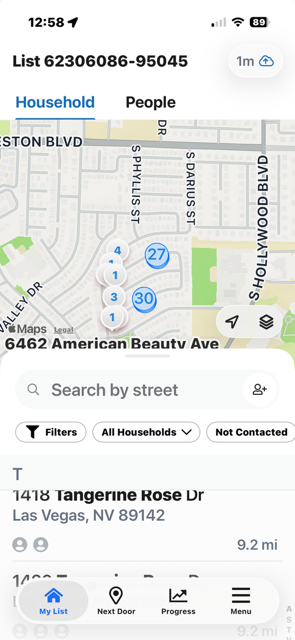
I spent the last four days in Las Vegas canvassing for Democratic candidates. It was tiring and not infrequently boring. It was also the most meaningful political work I’ve ever done.
Using my “MiniVAN” app, I moved from one address to another, knocked on doors, mostly without response, and left campaign literature for Adam Ford, first-time gubernatorial candidate, and Dina Titus, Congresswoman seeking reelection for her seventh term. I worked alone, taking breaks periodically to escape the relentless Nevada sun and the temperatures, which were mostly in the mid-80’s. I don’t know exactly how many miles I walked or how many doors I knocked on. After a while, it all sort of blurs together.
But for all the tedium and tiredness, I found this work gave me a new perspective on our country and on what it means to participate in this kind of voter mobilization. It was an eye-opening experience in a number of ways.
For the most part, I was assigned to canvass in east Las Vegas, a mostly working class area of the city. These voters, all registered Democrats, lived in sprawling complexes of very modest apartments or in houses, many of which appeared to be in various states of disrepair. These were not like neighborhoods I typically visit, and the people I met mostly appeared to be far less affluent that those in my circle of friends and acquaintances. Though, of course, I do not know the specific economic circumstances of any of the people I met, I got glimpses into a world of people for whom our economy and political system is not working.
For context, I should add that I’m an introvert by nature, not especially comfortable picking up conversations with complete strangers. And while I had done some canvassing in years past, this was by far the longest and most concentrated experience of door-knocking in my life.
Despite that, I found it less difficult than I would have imagined. I didn’t rely much on the pre-loaded script in my MiniVan app; most people didn’t want to engage in a lengthy conversation, if they wanted to talk at all. I simply introduced myself as a volunteer for the NV Dems and proceeded to talk with them about voting. And sometime late on that first day it dawned on me: this is how democracy works.
I was just one citizen talking to others about participating in the most fundamental privilege of citizenship in a democracy—choosing our elected leaders through the act of voting. To be sure, this was a partisan exercise. My job was to get out Democratic voters and make sure they had the information they needed to cast their ballots. But I was also just reminding people of the importance of getting out and participating in the democratic process. I had more than one opportunity to tell someone that voting matters, that it’s about electing people who might improve our lives in ways that we all want.
Part of what made all this so impactful is precisely that I so rarely do it—either engage with people so outside of my social circle or talk with strangers about politics. Canvassing requires both. The practice of walking door-to-door and talking with others about participating in our democratic system is precisely how we continue to instill a sense of civitas in our society, a belief that we are collectively committed to creating a society in which we determine how we will govern ourselves.
Among the hundreds of doors I knocked on, I talked with relatively few people. But in those interactions I experienced a sense of solidarity, a desire to express through my actions and words that as citizens we have something we can do to improve our country. I began to sense that this common goal—that as citizens of a democracy we contribute to the processes of our own government—was precisely what made all that canvassing so worthwhile.
For unlike letter or postcard writing, texting, or phone banking, when we knock on people’s doors, we’re looking them in the face. That directness, just being present to another person and talking about politics, is part of what holds our society together. Such conversations focus our attention on the fact that, despite being strangers, we have something profound in common.
I can’t say how many of the people I talked to—and the many others who only returned home to find campaign literature on their doorstep—were influenced to vote, much less to support the Democratic candidates. But I am certain that I emerged from the experience keenly aware of just how much democratic government depends on these sorts of interactions among strangers. It felt at moments like a kind of civic exercise more than merely a task undertaken.
There were some long stretches when I made no connections at all. The thought crossed my mind, “well, I don’t know if I’m accomplishing much, but at least I’m getting my steps in.” That’s it, I thought. What I’m doing is walking to keep our civic life strong. Call it “stepping up for democracy.” It’s not just that this is the way retail politics is done. It’s an opportunity to affirm something essential to sustaining government of, by, and for the people.